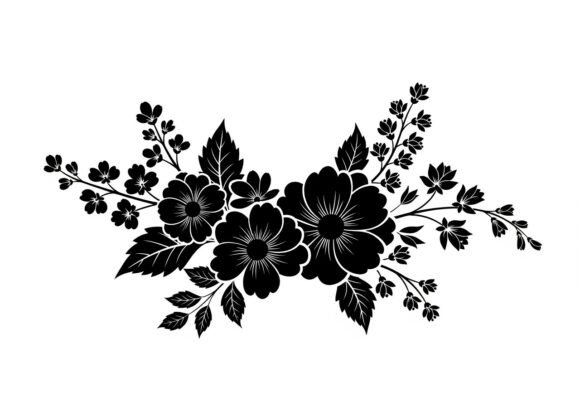
Black Floral Arrangement Flowers
A Designer’s First Glance: Bold, Botanical, and Quietly Confident
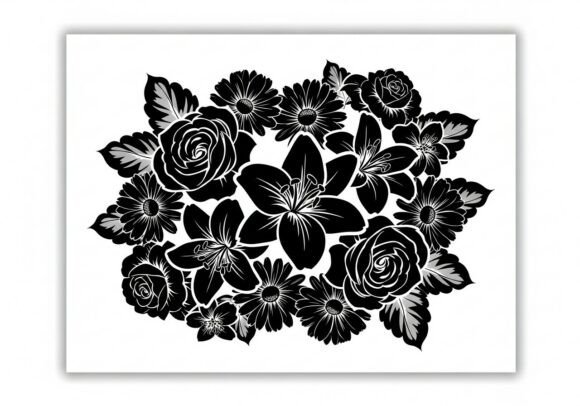
When Black Floral Arrangement Flowers landed in my inbox, I paused—not because it screamed for attention, but because it withheld it. That’s rare. This isn’t a fussy bouquet or a hyper-detailed botanical study. It’s a clean, high-contrast silhouette: black florals with crisp white outlines against a transparent background. The composition feels intentional—branches flow, leaves unfurl with subtle asymmetry, and the white outline does more than define shape—it lifts the design off the fabric before a single stitch is laid down. It reads as decorative, not literal; ornamental, not illustrative. For embroidery, that’s gold.
Real Project Test: A Linen Tote Bag for a Local Boutique
Last week, I used Black Floral Arrangement Flowers to embroider a set of heavyweight linen tote bags for a neighborhood apothecary shop. Their branding leans minimalist, earthy, and tactile—no glitter, no script fonts, just honest materials and quiet elegance. I placed the design centered on the front panel, scaled to 4.2 inches tall. On unbleached linen, the black thread (Polyneon 40) popped cleanly, and the white outline—stitched in a slightly lighter grey thread—created just enough lift to keep the motif from flattening into the texture. Customers didn’t say “Oh, pretty flowers.” They said, “That looks *made*—not printed, not stamped, but *stitched*.” That distinction matters. It’s what turns a tote bag into a keepsake.
Where This Design Shines (and Where It Asks for Thought)
Black Floral Arrangement Flowers thrives where clarity and calm coexist:
- Custom apparel: Works beautifully on sweatshirts and structured tees—especially crewnecks and boxy silhouettes where the floral flow echoes garment lines.
- Baby and nursery items: Stitched on organic cotton swaddles or muslin pillow covers, it reads gentle and timeless—not cutesy, not clinical.
- Embroidered patches: Its strong silhouette holds up beautifully when cut and fused. No lost detail at the edges.
- Kitchen and home textiles: Tea towels, aprons, and linen napkins gain instant sophistication without visual noise.
- Holiday and wedding gifts: Think monogrammed linen handkerchiefs or embroidered guest towels—elegant, gender-neutral, and quietly meaningful.
But—and this is where experience kicks in—Black Floral Arrangement Flowers asks for thoughtful placement. Avoid tight curves like cap fronts unless you’re willing to split the design across panels. On stretchy knits, the white outline can blur if stabilizer isn’t firm enough. And on dark fabrics? The white outline becomes your anchor—but only if your thread contrast is precise. I tested it on navy French terry and found that switching to a true white rayon (not off-white) made all the difference in legibility.
What It Does for Your Craft Business (Beyond the Stitch)
As an Etsy seller and small shop product developer, I pay attention to how a design affects perceived value—and Black Floral Arrangement Flowers raises it. Why? Because it looks handmade *without shouting*. No dense fill stitches competing for attention. No tiny petals begging for rehooping. Just confident, open negative space and deliberate line work. That translates directly to customer trust: buyers assume care was taken, time was invested, and the result wasn’t rushed. For personalized gifts—like a custom embroidered baby blanket—the design feels special but never overwhelming. It doesn’t dominate the recipient; it honors them.
It also plays well with branding. Whether you’re building a cohesive line of botanical-themed kitchen goods or launching a capsule collection of embroidered loungewear, Black Floral Arrangement Flowers serves as a flexible signature—not a one-off motif. Use it alone, repeat it as a subtle border, or layer it lightly behind a monogram. Its graphic nature means it scales cleanly across digital mockups, packaging, and social previews.
Practical Embroidery Designer Notes (No Fluff, Just What You Need)
Before stitching Black Floral Arrangement Flowers into your next project, do these five things:
- Test on scrap fabric first—same weight and weave as your final piece. Linen behaves differently than cotton poplin, and both react uniquely to satin vs. running stitch outlines.
- Check thread color contrast in natural light. That “white outline” only reads as white if your black thread is rich and your white (or light grey) thread is bright enough to separate visually.
- Review stitch density. Since this is an Illustrations-category graphic—not an applique design—it likely relies on clean line work and minimal fills. Confirm there’s no unintended heavy underlay hiding in the file.
- Confirm hoop size compatibility. Flowing branches mean width matters more than height. Don’t force it into a 4x4 hoop if the natural spread is 5.5 inches wide.
- Verify licensing for commercial use. As a Graphics file intended for embroidery projects, confirm whether resale of finished embroidered items is permitted—and whether digital redistribution (e.g., as part of a design bundle) is allowed.
Final Thought: Less Is Anchored, Not Empty
Some embroidery designs try to impress with complexity. Black Floral Arrangement Flowers impresses with restraint. It doesn’t need embellishment. It doesn’t beg for color variation or extra flourishes. Its strength lies in its silence—the confidence of a single, resolved idea translated into thread and fabric. If your work values intention over ornament, craftsmanship over clutter, and quiet beauty over loud trends, this isn’t just another floral arrangement. It’s a reliable, repeatable, deeply usable piece of design language—one that earns its place on everything from a child’s onesie to a boutique’s limited-edition linen pillow cover. Just remember: let the outline breathe, respect the fabric’s voice, and stitch like you mean it—not to fill space, but to honor the shape.